

[Editor’s Note: This is a guest post by my friend, a radiology resident, first-time contributor and future collaborator… the one and only Future Proof M.D.* You can follow more of his adventures at futureproofmd.com*. This post was placed with his permission (and suggested by him). It was originally published here]
In my Introduction to Investing post, I talked a little about the different types of financial instruments you can invest in. Today I want to explore further what kind of returns you can reasonably expect from the most common investment vehicles. Keep in mind the focus is on “long term” which means your mileage may vary (YMMV) in any given year. And as they always say in the financial industry – “past performance is no guarantee of future results.”
STOCKS (EQUITY)
SOURCE: HTTP://WWW.MULTPL.COM/
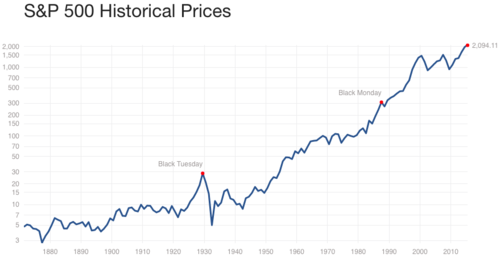
When you hear people talk about “the market,” they are usually referring to a stock market index – a selection of companies who are felt to be representative of an economy or a portion of an economy. In the US, the two most widely used indices are the Dow Jones Industrial Average (DJIA) and the Standard & Poor’s 500 (S&P 500). The S&P 500 is commonly used as a proxy for the greater US economy at large:
- 1928-2014: Geometric Average gain of 9.6%. If you had put in $100 in 1927, you’d have $289,995 in 2014.
- 1965-2014 (Last 50 years): Geometric average gain of 9.84%.
- 2005-2014 (Last 10 years): Geometric average gain of 7.60%, inclusive of the 2007-2010 recession.
BONDS (DEBT)
SOURCE: HTTP://WWW.MULTPL.COM/
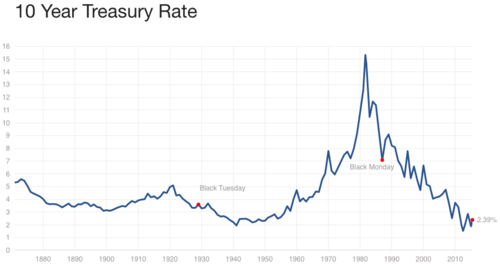
The most recognizable bond is the US Treasury Bonds (T-Bills, T-Notes, T-Bonds), it’s about as close as you can come to a risk-free investment since Uncle Sam ALWAYS pays. The price you pay for such a low-risk investment is a low rate of returns. The 10-year T-Note has become the most frequently quoted instrument when discussing the US bond market. Using the 10-year T-Note as a benchmark:
- 1928-2014: Geometric average gain of 5.00%. If you had put in $100 in 1927, you’d have $6,972 in 2014.
- 1965-2014 (Last 50 years): Geometric average gain of 6.70%.
- 2005-2014 (Last 10 years): Geometric average gain of 4.88%.
REAL ESTATE
SOURCE: HTTP://WWW.MULTPL.COM/
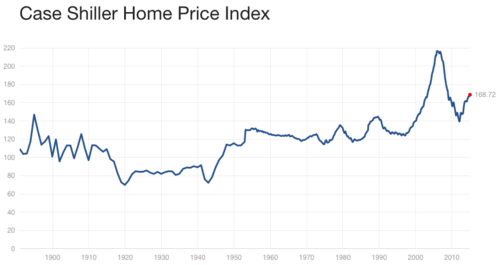
“Should I invest in stocks or real estate?” is a common question. Unfortunately it remains a commonly asked question because there is no simple answer. For one, are you planning to purchase a home to live in or to rent out? If you are purchasing to live in, then you are gaining value in the sense that you get to live in the house. But from the pure price appreciation perspective, a house is a terrible investment. Quoting Nobel Laureate economist Robert Schiller of the Case Shiller Home Price Index fame, since 1890,
“Home prices have increased only 1.5-fold, or only 33 basis points [That’s 0.33%!] a year. Essentially, home price capital gains overall have amounted to virtually nothing.”
Personally, I choose to put almost all of my investments in stocks – 92.3% of all managed assets to be exact – as I believe I have a long runway ahead and over the long term, stocks have the best performance. What about you? Where do you park your extra cash?
Further reading recommended by FutureProofMD*:
- CNBC: Where to put your cash? A house or a stock
- Charts and graphs sourced from http://www.multpl.com/
- Financial Samurai: Which Is A Better Investment: Real Estate Or Stocks?
- Historical data from Damodaran Online
You can find out more out FutureProofMD* and follow his latest adventures at www.futureproofmd.com*.